
How to Drive Safely on Ice and Snow: A Complete Winter Driving Guide
Driving on ice and snow requires different techniques than dry pavement. Here's a complete, practical guide to staying in control all winter.
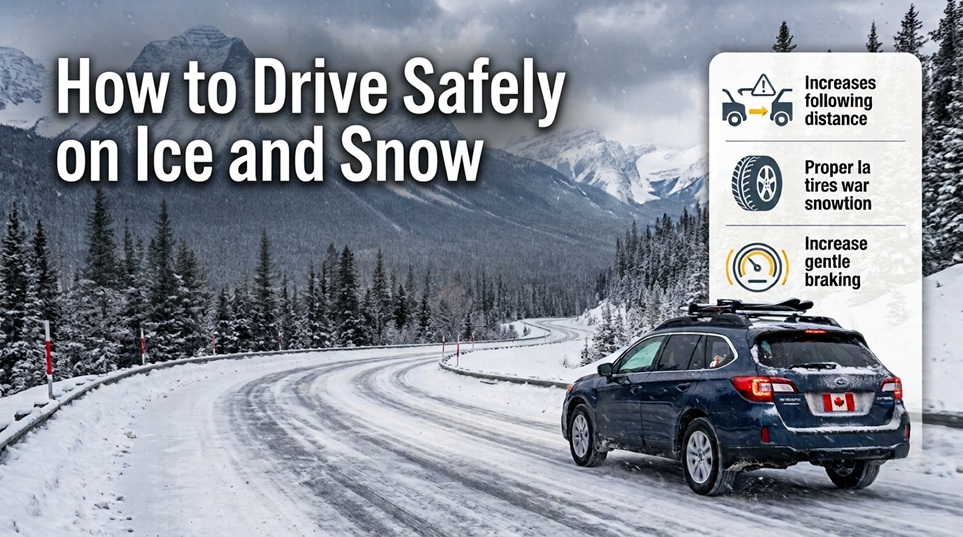
Driving on ice and snow rewards a completely different set of instincts than driving on dry pavement. The habits that work well in summer — quick steering corrections, firm braking, accelerating out of turns — can actively cause a loss of control in winter conditions. This guide covers the core techniques every Canadian driver should know before the first snowfall.
Slow Down Before You Need To
The single biggest technique in winter driving isn't a special maneuver at all — it's simply carrying less speed into every situation. Slower speeds give your tires more time to find grip, give you more time to react, and dramatically shorten the distance needed to stop if something goes wrong.
How to Brake on Ice and Snow
If your vehicle has anti-lock brakes (ABS), which almost all modern cars do, apply firm, continuous pressure to the brake pedal and let the system pulse the brakes for you — do not pump the pedal yourself. If you feel a strong vibration through the pedal, that's the ABS working correctly, not a malfunction. On older vehicles without ABS, gentle, rhythmic pumping of the brakes helps avoid a full lockup that would send you into an uncontrolled skid.
How to Accelerate Without Losing Traction
Apply the throttle gently and progressively from a stop, rather than flooring it. If your wheels start to spin, ease off immediately rather than adding more power, which usually only digs you in deeper or sends the rear of the vehicle sideways.
Steering Through a Skid
If the rear of the vehicle starts to slide, steer gently in the direction you want the front of the car to go — often described as "steering into the skid" — and avoid overcorrecting, which is what causes many skids to become a fishtail in the opposite direction. Keep your inputs smooth and small.
Driving Uphill and Downhill in Snow
Build a small amount of momentum before a snowy hill rather than trying to accelerate hard partway up, which usually just spins the wheels. Going downhill, reduce your speed before the descent and use light, steady braking rather than braking hard partway down, where you have less traction margin to work with.
What to Do If You Get Stuck
Getting stuck in snow is common even for careful drivers, especially in unplowed lots or after a heavy storm. Our detailed guide on how to get your car unstuck from snow covers ten safe methods, from traction aids to rocking the vehicle correctly.
When Not to Drive at All
Sometimes the safest winter driving technique is not driving. If a significant weather warning is in effect, if visibility is severely reduced, or if local authorities are advising against travel, the safest choice is to delay your trip. Review our broader list of 10 essential winter car safety tips and our region-by-region breakdown in winter driving tips for Canadian roads for more context on when conditions cross the line from difficult to dangerous.
Frequently Asked Questions
Is it better to drive in a lower gear on snow and ice?
In vehicles with manual transmissions or manual shift modes, a lower gear can help with engine braking on descents and smoother power delivery on climbs. In most modern automatics, the transmission already manages this well on its own.
Does all-wheel drive mean I can drive at normal speeds in snow?
No. AWD and 4WD improve acceleration traction, but they do nothing to improve braking or cornering grip on ice and snow. See our comparison of AWD vs. 4WD vs. FWD in winter for a full breakdown of what each drivetrain actually helps with.
About the author
NorthGrip Admin
Editor-in-chief at NorthGrip Auto.
Stay Winter-Ready
Get more winter driving tips and car care guides in your inbox.
Read Next
How to Drive Uphill and Downhill Safely on Snow and Ice
Hills change everything on snow and ice. Here's how to drive uphill and downhill safely, from momentum management to engine braking.
How to Stop Safely and Handle a Skid on Snow and Ice
Braking distances triple on ice, and skids happen fast. Here's how to stop safely on snow and ice, and what to do if your car starts to slide.
How to Drive Safely on a Snow-Covered Highway
Highway speeds make snow-covered roads more demanding. Here's how to drive safely on a snow-covered highway across Canada.